All it often takes is stepping over the threshold of an old palace or a hidden riad to fall instantly under the spell of Moroccan zellige, that fascinating mosaic that dresses the walls in its unique colors. You can already picture redoing your kitchen backsplash or setting up a beautiful table on your terrace, convinced you've found the perfect decor touch, except that real zellige is not just standard tile that you install and forget about. It's a living, temperamental, irregular material, born of earth and fire, whose making relies on complex know-how, often imitated but never matched by industry. So, to avoid confusing true craftsmanship with a low-end copy, and above all to understand why these small imperfect tiles are so precious, we take you behind the scenes of the workshops to learn everything about this treasure, from its ancestral firing to its successful installation in your home. For example, did you know that Moroccan zellige is assembled upside down? That's one of the little secrets we reveal here! Follow the guide!
The Heritage of Moroccan Zellige: From Al-Andalus to Modern Palaces
To grasp the whole history of Moroccan zellige, you have to go back in time to the 10th century. This art wasn't born in isolation; it is the fruit of a rich artistic dialogue between the Kingdom of Morocco and Muslim Andalusia. At that time, artisans and architects moved freely, exchanging knowledge that would give birth to masterpieces. And Morocco managed to preserve and enrich this Moorish heritage, making cities like Fez and Marrakech the guardians of this centuries-old treasure.
Today, zellige in Morocco has become the undisputed emblem of the country's visual identity. It adorns both the sacred and the profane. You find it decorating the walls of madrasas (Quranic schools) and the columns of mosques, where its geometric patterns invite endless meditation. But it is also the soul of private riads, bringing freshness and color to the patios. It's impossible to picture Moroccan architecture without these shimmering mosaics.
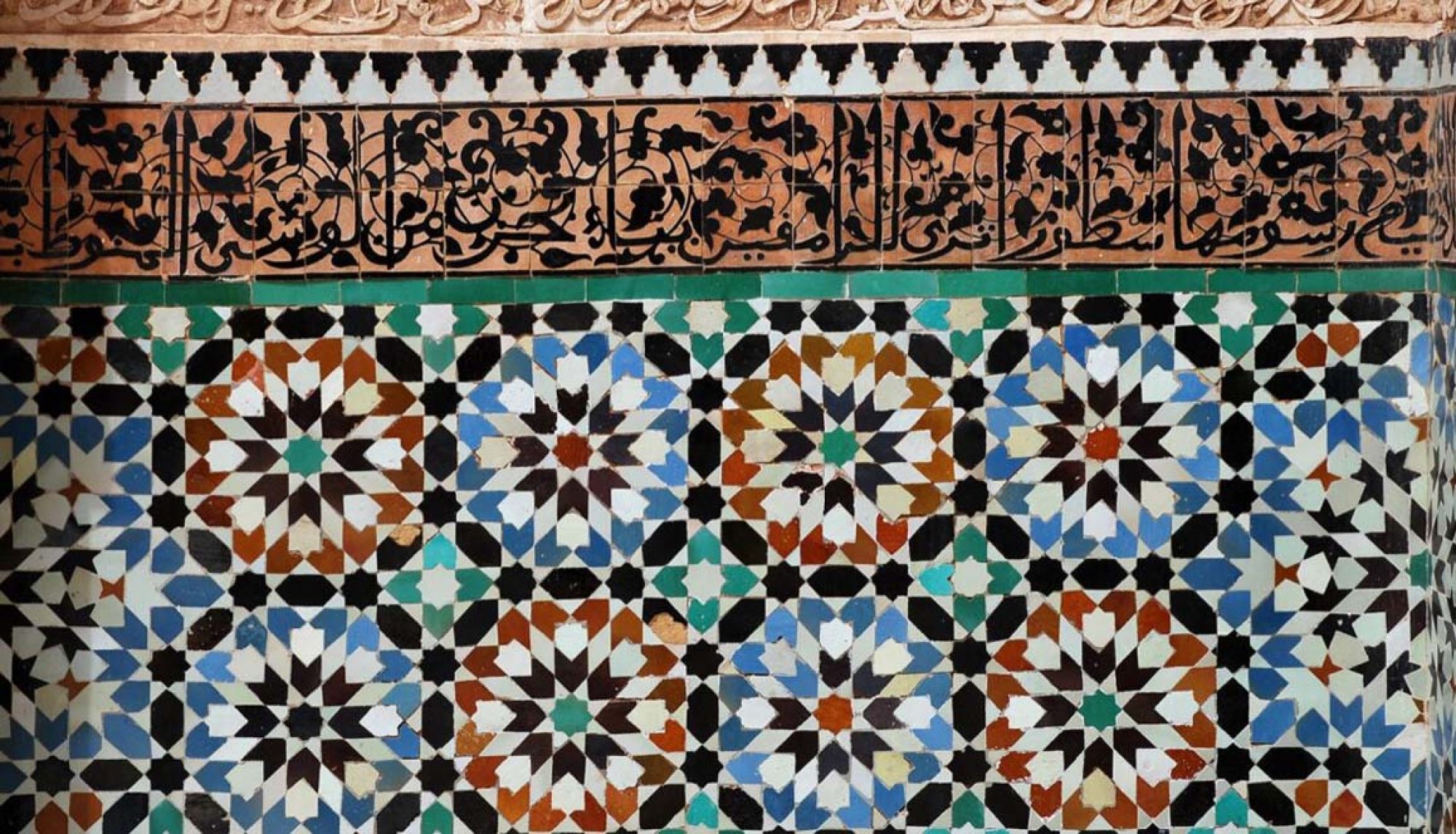
Yet what fascinates decor lovers the most is its uniqueness. Unlike industrial tile, smooth and uniform, every piece of Moroccan zellige is proudly imperfect. It's the human hand and the whims of fire that decide the surface. These slight irregularities are not flaws, quite the opposite: they are what catch the light unevenly. It's precisely this living surface that creates a unique visual "vibration," changing with the time of day, that you will never find with a factory imitation.
Mosaic of the Hassan II Mosque, a masterpiece of zellige in Morocco
Manufacturing Secrets: The Alchemy of True Moroccan Zellige
While the final result is absolutely exquisite, its birth takes place in dust, water and intense heat. Making zellige in Morocco can't be improvised; it's a long process, unchanged for centuries, that demands total mastery of the four elements.
Gray Clay from Fez: The Base of Moroccan Zellige
It all starts underground. The secret of the strength of Moroccan zellige lies above all in its raw material: a very particular gray clay, mainly extracted in the Fez region. Why this one? Because it has a unique geological composition that, once fired, offers exceptional strength while remaining soft enough to be cut without breaking.
In the workshops, this raw clay is first soaked in basins (the zallagh) to soften it. Next comes the physical step of kneading, often done by hand, to drive out air bubbles and obtain a smooth, pliable paste. The tiles are then molded and left to dry for a long time under the blazing Moroccan sun before meeting the fire.
Firing and Glazing: The Secret of the Colors
Once dry, the tiles go through a first firing to become terracotta biscuits. This is when the artist steps in for the enameling. The artisans apply the colored glaze to the top face by hand.
The traditional colors of Moroccan zellige are obtained using natural pigments like cobalt for the famous Fez blue, copper for emerald green or iron for honey. The tiles then go back for a second firing in traditional kilns. The magic happens here: the heat isn't uniform like in an electric oven. Depending on the tile's position (closer to or farther from the flames), the color varies subtly. It's this uncontrollable alchemy that creates infinite nuances, giving the finished wall that impression of vibrating.
The Maâlem's Touch: Precision Cutting and Assembly
This is the most impressive step, the one that commands respect. Once the tile is glazed and fired, it passes into the hands of the Nakkach. Sitting cross-legged (literally!), he traces the geometric shapes on the glaze, then, equipped with a heavy, sharp hammer called the menkach, he cuts each piece one by one on a small block (the senaï). The movement is quick and controlled. He cuts the edges at a bevel toward the inside to allow an assembly accurate to the millimeter, making the joint almost invisible.
But the real tour de force lies in the assembly. Unlike Western methods, the mosaic of Moroccan zellige is put together upside down! The artisans lay out the thousands of pieces glazed side down on the floor, drawing the pattern "blind" and from memory. They only discover the final result once the panel is turned over. A technique unique in the world that demands absolute concentration.
Want to test your dexterity? It's hard to understand the complexity of this craft without holding the hammer yourself. If you're passing through Morocco, we invite you to live this unique experience during our zellige workshop in Marrakech. You'll be able to step into an artisan's shoes and create your own mosaic.
The Art of Living: How to Bring Moroccan Zellige into Your Home
Having zellige at home isn't simply laying tile; it's importing a piece of the Moroccan art of living, a touch of sun and history that instantly warms up a room. But how do you adopt it without turning your home into a movie set?
Zellige in Contemporary Decor
Long confined to the traditional Oriental style, Moroccan zellige has made a splashy entrance into modern interiors. Interior designers are snapping it up to give character to clean, minimalist spaces.
As a kitchen backsplash: It brings texture and breaks up the monotony of lacquered cabinets.
In the bathroom: For a "beldi-chic" style, use it in touches, in a shower niche or behind a sink.
As an accent wall: The play of light on the irregular glaze gives an incredible depth that neither paint nor wallpaper can imitate.
The Moroccan Zellige Table: The Centerpiece of the Terrace
It's often travelers' first love at first sight. The Moroccan zellige table is much more than garden furniture, it's an invitation to conviviality. Set on a heavy wrought-iron base, its mosaic top withstands everything: blazing sun as well as bad weather. It's a lasting investment that goes through the years without aging a day. Whether you choose a complex pattern or a solid color, this table becomes the soul of your terrace, bringing that relaxed elegance typical of outdoor lunches in Marrakech.
The Moroccan Zellige Fountain: An Oasis of Coolness
Close your eyes and listen. The sound of water trickling over glazed ceramic is therapy all on its own. Installing a Moroccan zellige fountain in a garden, or even on a simple urban balcony, instantly recreates the soothing atmosphere of an Andalusian patio. Beyond being a decorative object, it becomes a point of visual and sonic freshness, turning your outdoor space into a true haven of peace, far from the tumult of the city.
Tips: Buying, Choosing and Caring for Your Zellige
Are you sold and ready to take the plunge? Be careful, though: the worldwide success of Moroccan zellige has led to mass industrial production that has nothing of zellige but the name. Here's how to navigate this market and take care of your future treasures.
How to Recognize Authentic Moroccan Zellige
This is the golden rule: keep your eyes open! Real handcrafted zellige is recognizable by two foolproof clues.
The beveled cut: Look at the edge of the tile. On real zellige cut with the menkach, the edges are beveled toward the back. It's this angled cut that lets the tiles touch almost perfectly on the surface while leaving room for the mortar underneath. A straight, clean cut? That's machine cutting.
The vibration of the color: If you take ten tiles and they all have exactly the same uniform shade, run. Real zellige shows subtle variations (a deeper blue, a lighter green) due to firing over a wood fire. It's this "breathing" of the color that proves its authenticity.
How Much Does Real Handcrafted Moroccan Zellige Cost?
You shouldn't compare the price of zellige to that of mass-market tile. Buying Moroccan zellige means paying for hours of manual work, from kneading the clay to the meticulous cutting of each piece. It's goldsmith-level work.
To give you an idea, quality genuine Fez zellige (standard 10×10 cm format) generally goes for between 100 € and 150 € per m² at specialist retailers in Europe. If you get the chance to buy it directly in Morocco, from reputable cooperatives or workshops, the price often ranges between 450 and 800 dirhams per m² (about 40 € to 75 €), excluding shipping and customs fees.
If the price seems laughably low (below 80 €/m² in France, for example), it's often a sign of mediocre quality (crumbly clay, poorly controlled firing) or worse, of industrial production that imitates the look without having the soul. See it as a heritage investment that adds value to your property.
Caring for Moroccan Zellige: Our Tips and Tricks
Good news: zellige is sturdy and easy to maintain. The glaze protects the terracotta and cleans very well.
Daily care: Forget harsh detergents or bleach that could dull the shine of the glaze over time. Warm water and a little black soap (or a mild soap) are plenty.
The shine trick: To restore some sparkle or remove limescale marks (especially in a bathroom), a little white vinegar diluted in water will work wonders without harming the material. That's the whole charm of "beldi": simple methods for noble materials.
At the end of this journey into the heart of the material, you understand that Moroccan zellige is much more than a simple decorative covering; it's a piece of history, a vibrant testimony to a know-how where the human hand patiently converses with earth and fire. Choosing zellige for your home means accepting this share of "imperfect beauty" and inviting the soul of Morocco into your space. But reading the history is one thing, living it is another. If you want to go from theory to practice and feel the vibration of the hammer in your palm, we invite you to push open the door of our zellige workshop in Marrakech. Come meet our master artisan, learn traditional cutting and leave with your own creation, an indelible souvenir of your time in the ocher city.
L´article est très intéressant, et enrichissant, j´ai apprécié le sujet. Merci pour toutes les informations sur le Zellige, cet article m´a aidé dans ma recherche.


L´article est très intéressant, et enrichissant, j´ai apprécié le sujet. Merci pour toutes les informations sur le Zellige, cet article m´a aidé dans ma recherche.